
By: John Silva – April 28, 2017
Hey Dad, can you help me with my homework? Well, I was gonna watch the ballgame, but you know what? I’d rather spend this time with you. But, before I answer… What grade are you in? Fifth grade… Dad. Kid, I think I can manage it… let’s give it a go. Ok, Dad. Are you ready? Yep! Dad… how did life begin? What? Are you kidding me? That’s the first question? Yep, Dad.
Well, if I understand the science of the day. First there was nothing… and then there was a Big Bang… and ten or so billion years later.. there was an earth… and about four billion years later… there was us… and all of this happened by itself without any outside assistance.
Ok dad, let me see if I got this. First we have nothing, and then there’s the bang, and we have all kinds of stuff… like matter, energy, gravity, light, gasses, liquids, solids and I guess plasma. Is that right dad? Yea… I think you got it. So, now we have stuff and ways it can move around. And, nobody was there to make it happen, and we don’t have a clue where it all came from… just a bang. Damm, dad… that’s a lot to swallow. Hey, kid… watch your language!
Son, even though I agree with you… at least for the moment, I guess we’re gonna have to go with what they are telling us. But, you’re right… It does seem like a lot to take in. Anyhow, regardless of the uncertainty, we do have stuff that we can make into something, and ways for it to move around. Right? Right. So, Dad… how do we get life? In school they said it might be lighting and primordial soup.
Oh, please! I’m on a diet… and we are not going with primordial soup. No way. We need real science… not sloppy Joe’s soup!… say, did they happen to mention if it was split pea or chicken noodle? No, Dad.
Son, I think I see a problem… sumptin don’t add up. What’s that, Dad? Well, we got all of these scientists telling us what happened by chance, and they got sophisticated laboratories full of the best scientists on the planet. And, they can’t show us how it all happened… don’t make sense. I’d feel a whole lot better if they would just take us to their labs and show us how it’s done. Well, dad we’re here… aren’t we? So, something must have happened for life to get started.
Son, you are so right. Let’s try it again. Hmmm… through random acts of some kinda force on some kinda matter the first building block of life occurred. Dad… what if there were several different kinds of first building blocks of life. Good point, son. So now, we got two choices… life came from a single event or it came from multiple events. Are there any other choices? Dad, maybe it was a combination of single and multiple origins hurtling through space and time on their quest to create life. Well said, son. Hey, where’d you learn to talk like that? I watch a lot of Star Trek, Dad. Hmm…
Son, I’m thinking if life started from a single event it would sorta look like a bullet fired from one of our hunting rifles. A single stream of events starting with the first life-form. On the other hand, it could look like a blast from a shotgun with life starting events flying all over the place. Quick, son. We are going to need somebody to make some sense out of all this chaos. Looks like things are about to get really messy. Maybe, I need a traffic cop. Oh, shoot! I forgot no intelligent help required or desired. Ain’t that so son? Yes, Dad.
Drat!… Houston, we have a problem. Son, we don’t even know what a “life starting event” looks like or how it starts? I mean if we are gonna be serious, we need to say something about it. Don’t we? Son, let’s get this figured out.
Hmm, I wonder how the football game is going? Hey, dad! Don’t jump ship now. We need to get this done now.
Does a “life starting event” start at the cellular level… or do we need the parts of the cell before we can have life… or do we need molecules before we can have parts… or do we first need genes… no, I think to have genes you first gotta have DNA or is it RNA… but, everything is made out of atoms so life must start with atoms… but, then again, wouldn’t that mean it would have to start from the subatomic level like from a proton or a neutron or something… or how about a quark? Come on now. It can’t be that hard to figure out.
Where does life begin? It has to start somewhere. Damn! So many questions. So much information. So few answers.
Dad, maybe life starts when all of the pieces are put together. Good point, son… but, before you assemble them, they’ve got to exist… don’t they? Sounds good, Dad. Son, what I can’t figure out how the little suckers that make up the bigger pieces of the cell get made, and then how do the bigger pieces assemble themselves into a cell?
Dad, maybe it’s a chemical reaction, and the chemicals get mixed together when a strong wind blows them around… maybe its when hurricanes and tornadoes keep slamming into each other. What do you think, dad? Son, I think, I favor the tornados because hurricanes have all that water sloshing around with the wind that could throw things off. But, then again… maybe not… oh heck, who knows?
Son, help me out here. These here parts… are they rifle or shotgun events. A rifle bullet event is like a straight event one, two, three, four etc. till it hits somethin or tuckers out. So, do the little parts that make up the big parts have to get made in the correct order like one, two, three, four etc. and do they all have to be available at just the exact time they are needed? Or, can they just lay around until all of the little parts make themselves? And, then the tornado spins them together in the correct order? Don’t know, dad.
The thing that still gets me is if it’s so dadgum simple, why can’t those brainy scientists replicate it? I mean… really? If life all started from unplanned events and random chances… how complicated could it be? I can’t stand it!!! Somebody… anybody… I need help!!! Son… call the Scientific American… or the Whitesonian… Better yet, Google it!
Hmm… maybe, I can’t get the answer because its too simple… yep that’s it! That’s why I can’t figure it out… I’m too smart!
Nagh…that can’t be it… first off I only had one year of high school biology, and that was almost sixty years ago… must be something else.
So, is it a rifle or a shotgun type of event? Son, somehow, we’ve got to get off the dime here. We have got to get some kind of a cell going so we can talk about how life got started. Let’s see… to have life we are gonna need the first cell… but, a cell is made of parts… Right? Right, Dad.
Hey, Dad. What? Google says to try Prokaryotes. And, son… just exactly what are Prokaryotes? Google Wikipedia says “… small, relatively simple cells surrounded by a membrane and a cell wall, with a circular strand of DNA containing their genes.” Son, sounds pretty simple. So, which came first… the membrane, the cell wall or the circular strand of DNA containing their genes? Don’t say, Dad. Son, when do the parts become viable? Dono. Where did the DNA strands come from? They don’t say. What are they made of and how did they get made? Nada. Boy, they are not much help… are they? Nope.
Well let’s just say, suppose life started with the membrane? So, now we got a lot of membranes floating around? Wait! Wait! Wait! Floating around? Did they say life started in the ocean or on land? Doesn’t say for sure pop, but they think it was the ocean. They think? They think? That’s all we got. Looks that way Dad.
Well son, even if we could figure out how all the pieces got made, I think we got ourselves another problem. What’s that Dad? Once you get all of the pieces made they all have to get put together. Don’t they? Son, how does that happen? Don’t know, Dad. Well, it gets even worse. How’s that Dad? Even if we could figure out how all of the parts got made, and how they all got put together… We still don’t have a clue as to how to make them parts come alive.
Son, something seems to be missing. This here puzzle ain’t got all its pieces. Best as I can figure out, it can’t be done. Well, dad… one thing fer sure… somehow we got here… because we are here aren’t we? You are right, son. So, maybe we are gonna have to go back to where we started, and see what we missed. I think so, dad.
Son… how many more questions are there?
Author’s note: If the answer to what is life and how it got started, was to be put into a book. The questions I just raised would be a small part of a small part of a small section of a serif of the first letter of the first word of the first sentence of the first paragraph of the first chapter of the book.
So, what’s missing? What could make it all work? What is needed to get from nothing to a universe, a galaxy, a sun, a planet and life? I wonder… would it be more logical if we included an intelligent creator?
Let’s put it another way. Science does really well when it sticks to discovery. However, sometimes science omits important information or it blocks out logical explanations because they don’t fit into its premise. I suppose you could say, it is not so much as to what they say… as to what they know but don’t bother to tell us.
The following terms are from Wikipedia, the free encyclopedia under the topic Archaea which is just one of several forms of a single celled organism. In one way or another, the following items and terms are used in the article.
Archaea, domain,, single-celled microorganisms, prokaryotes, cell nucleus, membrane-bound organelles, bacteria, Eukaryota, Haloquadratum walsbyi, phyla. Genes, nucleic acids, metabolic pathways, enzymes, transcription and translation, ether lipids, cell membranes, organic compounds, ammonia, metal ions, hydrogen gas, Haloarchaea, fix carbon, plants, cyanobacteria, reproduce asexually by binary fission, fragmentation, or budding, spores, plankton, extremophiles, environments, habitats including soils, oceans, marshlands, colon, oral cavity, and skin, carbon cycle, nitrogen cycle, pathogens, parasites, mutualists, commensals. Methanogens, digestion, Methanogens, biogas production, sewage treatment, enzymes, organic solvents, biotechnology, Eoarchean, Hadean, Proterozoic, Paleoarchean, Halobacterium, NRC-1, μm, Halobacterium, Kingdoms, phylum, Euryarchaeota, Scientific classification, DPANN, Aenigmarchaeota, Diapherotrites, Nanoarchaeota, Nanohaloarchaeota, Micrarchaeota, Pacearchaeota, Parvarchaeota, Woesearchaeota, Proteoarchaeota, Aigarchaeota, Bathyarchaeota, Crenarchaeota, Geoarchaeota, Korarchaeota, Thaumarchaeota, Asgard, Lokiarchaeota, Thorarchaeota, Odinarchaeota, Heimdallarchaeota, Archaebacteria, Mendosicutes, Metabacteria, Classification – New domain, Current classification, Concept of species, Origin and evolution – Comparison to other domains, Relationship to bacteria, Relation to eukaryotes, Morphology, Structure, composition development, and operation, Cell wall and flagella – Membranes, Metabolism, Genetics, Gene transfer and genetic exchange, Reproduction, Ecology – Habitats, Role in chemical cycling, Interactions with other organisms, Mutualism, Commensalism, Significance in technology and industry, References, Further reading, External linksuronian, Cryogenian, Andean, Karoo, Quaternary, ice ages, biochemistry, morphology and metabolism, phylogenetics, phylogenetic trees, ribosomal RNA (rRNA) genes, Archaebacteria, Eubacteria, Urkingdoms, Woesian Revolution, methanogens, extremophiles, hyperthermophilic microbes, polymerase chain reaction (PCR), ARMAN,molecular phylogenetics, Euryarchaeota, Crenarchaeota, Nanoarchaeum equitans, Nanoarchaeota, Korarchaeota, Crenarchaeota, Archaeal Richmond Mine acidophilic nanoorganisms (ARMAN), superphylum – TACK, Thaumarchaeota, Aigarchaeota, Crenarchaeota, Korarchaeota, horizontal gene transfer, Ferroplasma, Halorubrum, genetic diversity, rRNA sequence, life on Earth is graphite found to be biogenic in 3.7 billion-year-old metasedimentary rocks discovered in Western Greenland[36] and microbial mat fossils found in 3.48 billion-year-old sandstone discovered in Western Australia, biotic life, fossils, morphologies, lipids, eukaryotic lipid, shales, Isua district, evolution of cells, lateral gene transfer, thermophile, pseudopeptidoglycan, peptidoglycan, Ester-linked lipids, Circular chromosomes, translation and transcription, Multiple, linear chromosomes, methanogenesis, horizontal gene transfer, 16srRNA, methanogens, conserved signature indels, methanogenesis, prokaryotes…
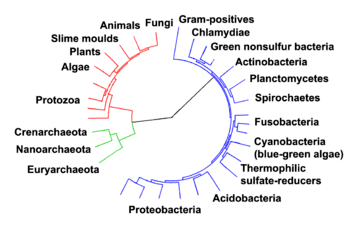
Phylogenetic tree showing the relationship between the Archaea and other domains of life. Eukaryotes are colored red, archaea green and bacteria blue. Adapted from Ciccarelli et al. (2006)[61]
Following this diagram are sixteen pages of text dealing with the topic of how life began, which will of course raise many more questions that are not asked or answered.
Following the sixteen pages of explanations are twelve additional pages listing the source material on which the sixteen pages are based.
Following are the main topics that are presented.
Classification – New domain, Current classification, Concept of species, Origin and evolution – Comparison to other domains, Relationship to bacteria, Relation to eukaryotes, Morphology, Structure, composition development, and operation, Cell wall and flagella – Membranes, Metabolism, Genetics, Gene transfer and genetic exchange, Reproduction, Ecology – Habitats, Role in chemical cycling, Interactions with other organisms, Mutualism, Commensalism, Significance in technology and industry, External linksuronian, Cryogenian, Andean, Karoo, Quaternary, ice ages, biochemistry, morphology and metabolism, phylogenetics, phylogenetic trees, ribosomal RNA (rRNA) genes, Archaebacteria, Eubacteria, Urkingdoms, Woesian Revolution, methanogens, extremophiles, hyperthermophilic microbes, polymerase chain reaction (PCR), ARMAN,molecular phylogenetics, Euryarchaeota, Crenarchaeota, Nanoarchaeum equitans, Nanoarchaeota, Korarchaeota, Crenarchaeota, Archaeal Richmond Mine acidophilic nanoorganisms (ARMAN), superphylum – TACK, Thaumarchaeota, Aigarchaeota, Crenarchaeota, Korarchaeota, horizontal gene transfer, Ferroplasma, Halorubrum, genetic diversity, rRNA sequence, life on Earth is graphite found to be biogenic in 3.7 billion-year-old metasedimentary rocks discovered in Western Greenland[36] and microbial mat fossils found in 3.48 billion-year-old sandstone discovered in Western Australia, biotic life, fossils, morphologies, lipids, eukaryotic lipid, shales, Isua district, evolution of cells, lateral gene transfer, thermophile, pseudopeptidoglycan, peptidoglycan, Ester-linked lipids, Circular chromosomes, translation and transcription, Multiple, linear chromosomes, methanogenesis, horizontal gene transfer, 16s rRNA, methanogens, conserved signature indels, methanogenesis, prokaryotes, Classification – New domain, Current classification, Concept of species, Origin and evolution – Comparison to other domains, Relationship to bacteria, Relation to eukaryotes, Morphology, Structure, composition development, and operation, Cell wall and flagella – Membranes, Metabolism, Genetics, Gene transfer and genetic exchange, Reproduction, Ecology – Habitats, Role in chemical cycling, Interactions with other organisms, Mutualism, Commensalism, Significance in technology and industry, References, Further reading, External linksuronian, Cryogenian, Andean, Karoo, Quaternary, ice ages, biochemistry, morphology and metabolism, phylogenetics, phylogenetic trees, ribosomal RNA (rRNA) genes, Archaebacteria, Eubacteria, Urkingdoms, Woesian Revolution, methanogens, extremophiles, hyperthermophilic microbes, polymerase chain reaction (PCR), ARMAN,molecular phylogenetics, Euryarchaeota, Crenarchaeota, Nanoarchaeum equitans, Nanoarchaeota, Korarchaeota, Crenarchaeota, Archaeal Richmond Mine acidophilic nanoorganisms (ARMAN), superphylum – TACK, Thaumarchaeota, Aigarchaeota, Crenarchaeota, Korarchaeota, horizontal gene transfer, Ferroplasma, Halorubrum, genetic diversity, rRNA sequence, life on Earth is graphite found to be biogenic in 3.7 billion-year-old metasedimentary rocks discovered in Western Greenland[36] and microbial mat fossils found in 3.48 billion-year-old sandstone discovered in Western Australia, biotic life, fossils, morphologies, lipids, eukaryotic lipid, shales, Isua district, evolution of cells, lateral gene transfer, thermophile, pseudopeptidoglycan, peptidoglycan, Ester-linked lipids, Circular chromosomes, translation and transcription, Multiple, linear chromosomes, methanogenesis, horizontal gene transfer, 16s rRNA, methanogens, conserved signature indels, methanogenesis, prokaryotes…
Additional internet searches will no doubt reveal other sites that also attempt to explain the origin of life… which will again raise many more questions. Perhaps the evolutionary biologists that espouse the theory of evolution would do well to ape (sorry… the pun really was intended) their learned colleges in astrophysics and cosmology… and just say it all came from nothing.