
By: John Silva – June 2018
Of course the elephant in the room is where did all of this matter come from? And you wouldn”t believe how much matter is out there. The problem with any number that gets too large is, can you relate to it. If I told you that the universe consisted of _____metric tons would it mean anything to you? Let’s see. Is the correct answer a. b. c. d. ?
Here is another problem of large numbersSay, I have two large dogs, and you have t2wo hundred large dogs. I understand that you have a lot more dogs than I do. I can also visualize two dogs living in my house with no problems… even large dogs. However, if the number of dogs living with me were to rise to two hundred, I don’t know if I could live with that many large dogs. First, my allergy to dog fur would go ballistic. Second, there would so many large dogs in the house that I would have trouble just walking from the kitchen to the living room. Third, who is going to pay for all of the dog food, medical bills, grooming costs etc. that I will need? Forth, who is going to clean up all of the dog poop? Fifth, what will my house smell like if they aren’t all bathed? You see, I can relate to the issue even if the number is two hundred.
However, what if I had two hundred trillion dogs and you had two hundred trillion trillion dogs? At some point the mind gives up. It can’t relate if the numbers get too large. Because in order for it to relate it needs something to relate it to.
A dollar is something we can relate to. Can you relate to a trillion or a trillion, trillion or a trillion, trillion, trillion dollars? A trillion dollars is equal to one thousand billion dollars. It is represented by the number 1,000,000,000,000 (A one followed by twelve zeros). The current debt of the United States is over 36 trillion dollars. If you spent a thousand dollars a day, it would take you almost three million years to spend a trillion dollars. Presently, there is no one in the world that has accumulated a trillion dollars.
What is matter?
Matter is what everything is made of… people, the universe, planets, water, frogs, black holes, oak trees, air, stars, dirt, zits, comets, the lint in your navel, supernovas… everything. So exactly what is it, and where did it come from?
For starters, explaining matter… is not a simple matter. Care for just a taste of the primordial soup? Consider the following two partial excerpts from Wikipedia. One concerns the big bang theory and the other the conservation of mass (i.e. matter). The first seems to say, everything was created from nothing after a big bang. The second seems to say, matter cannot be created or destroyed. Say… What? Are you kidding me? Nope… read on.
Big Bang – Wikipedia
(https://en.wikipedia.org/wiki/Big_Bang#p-search)
“The Big Bang theory is the prevailing cosmological model for the universe[1] from the earliest known periods through its subsequent large-scale evolution.[2][3][4] The model describes how the universe expanded from a very high-density and high-temperature state,[5][6] and offers a comprehensive explanation for a broad range of phenomena, including the abundance of light elements, the cosmic microwave background (CMB), large scale structure and Hubble’s law.[7] If the known laws of physics are extrapolated to the highest density regime, the result is a singularity which is typically associated with the Big Bang. Physicists are undecided whether this means the universe began from a singularity, or that current knowledge is insufficient to describe the universe at that time. Detailed measurements of the expansion rate of the universe place the Big Bang at around 13.8 billion years ago, which is thus considered the age of the universe.[8] After the initial expansion, the universe cooled sufficiently to allow the formation of subatomic particles, and later simple atoms. Giant clouds of these primordial elements later coalesced through gravity in halos of dark matter, eventually forming the stars and galaxies visible today.
Since Georges Lemaître first noted in 1927 that an expanding universe could be traced back in time to an originating single point, scientists have built on his idea of cosmic expansion. The scientific community was once divided between supporters of two different theories, the Big Bang and the Steady State theory, but a wide range of empirical evidence has strongly favored the Big Bang which is now universally accepted.[9] In 1929, from analysis of galactic redshifts, Edwin Hubble concluded that galaxies are drifting apart; this is important observational evidence consistent with the hypothesis of an expanding universe. In 1964, the cosmic microwave background radiation was discovered, which was crucial evidence in favor of the Big Bang model,[10] since that theory predicted the existence of background radiation throughout the universe before it was discovered. More recently, measurements of the redshifts of supernovae indicate that the expansion of the universe is accelerating, an observation attributed to dark energy‘s existence.[11] The known physical laws of nature can be used to calculate the characteristics of the universe in detail back in time to an initial state of extreme density and temperature...[12]
Timeline of the metric expansion of space i.e. The Big Bang, where space (including hypothetical non-observable portions of the universe) is represented at each time by the circular sections. On the left, the dramatic expansion occurs in the inflationary epoch; and at the center, the expansion accelerates (artist’s concept; not to scale).
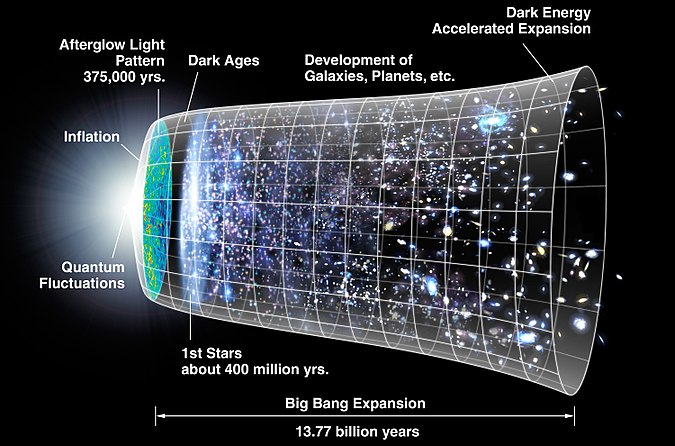
Short Version: The big bang theory posits everything in the universe was created as a result of the big bang… including but not limited to matter.
Also, notice nothing exists prior to the model leaving one to wonder… how the big bang produced everything from nothing?
Conservation of mass – Wikipedia (https://en.wikipedia.org/wiki/Conservation_of_mass)
The law of conservation of mass or principle of mass conservation states that for any system closed to all transfers of matter and energy, the mass of the system must remain constant over time, as [a] system’s mass cannot change, so quantity cannot be added nor removed. Hence, the quantity of mass is conserved over time. The law implies that mass can neither be created nor destroyed, although it may be rearranged in space, or the entities associated with it may be changed in form… Simply stated, the First Law of Thermodynamics i.e. the Law of Conservation of Matter states matter can neither be created nor destroyed.
A long and complex trail of theories follows this paragraph involving quantum physics, dark matter, the spacetime continuum, E=mc2, and a lot, lot more.
Is this true or a conundrum, doublespeak, or just plain babble? How can the big bang create all of the matter in the universe when the law of conservation of mass or the principle of mass conservation states that for any system closed to all transfers of matter and energy, the mass of the system must remain constant over time, as [a] system’s mass cannot change. A short version of the Law of Conservation of Matter could simply state that matter can neither be created nor destroyed.
*I hope I’ve given your brain an itch to scratch. Not enough to ponder? Consider the following thought. Suppose our universe began as a universe without time… time simply didn’t exist. There would be no beginnings or ends… there would just be now. If this were so, does it shed any light on the question. What was here before the big bang?
It seems counterintuitive to think that everything in our universe came from nothing… which really doesn’t explain anything… I think… or I think I think not much…. What do you think?